Submandibular Gland Reduction
Beverly Hills, CA


A defined neck and jawline depend on more than skin and fat. In some patients, the submandibular glands sit low enough beneath the jaw that they create visible fullness even after a well-performed facelift or neck lift.
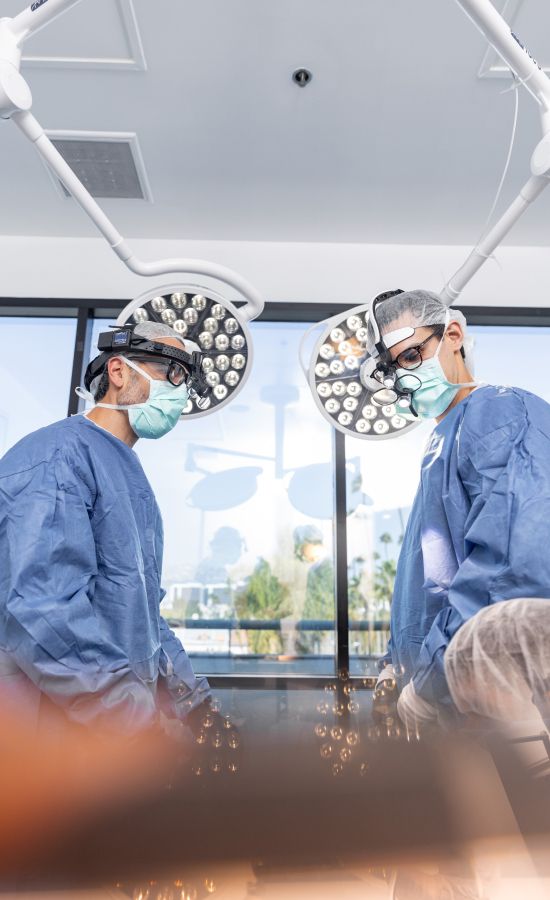
At Eos Rejuvenation in Beverly Hills, submandibular gland reduction may be incorporated into facelift or neck surgery for appropriately selected patients. The procedure is highly anatomical and requires an experienced surgeon who understands the deeper structures of the neck, including the salivary glands, nerves, muscles, and vessels that surround them.
The submandibular glands are two of the major salivary glands located beneath the lower jaw. Their job is to produce saliva, and in most people they sit deep enough that they are not especially noticeable from the outside.
Over time, however, a submandibular gland can descend or become more visible as surrounding tissues change. Some patients also naturally have more prominent glands, creating fullness beneath the jaw even when there is very little excess fat.
Submandibular gland reduction involves carefully removing a portion of the visible gland rather than removing the entire structure. The amount of partial removal is based on the patient's anatomy and how much gland prominence contributes to the appearance of the neck.
Because the remaining salivary glands continue producing saliva, this procedure is planned with both aesthetic and functional outcomes in mind.
A facelift can reposition descended facial tissues, while a neck lift can tighten the platysma muscle, address deep fat, and improve the transition between the chin, jaw, and neck. Liposuction can also be helpful when excess fat is contributing to fullness.
The submandibular gland sits deeper than the fat that can be removed with liposuction, which means a patient can still have visible fullness beneath the jaw after the surrounding tissues have been tightened. Once the jawline becomes cleaner, the gland may actually become easier to see.
For the right patient, gland reduction allows the deeper neck contour to match the improvement created by facelift surgery. This can produce a cleaner angle beneath the jaw and a more continuous transition from the chin into the neck.
When gland prominence is a meaningful part of the neck anatomy, reduction may help:

Submandibular gland reduction is not automatically included with every neck lift or deep plane facelift.
A good candidate has visible gland prominence that is contributing to excess fullness beneath the jaw. The area should be evaluated carefully because several structures can create a similar appearance, including deep fat, the digastric muscle, loose platysma, skin laxity, and the position of the gland itself.
During a thorough consultation, the surgeon examines the neck from multiple angles and identifies which tissues are actually contributing to the contour. This allows the surgical plan to address the right structure instead of treating all submental fullness as a double chin.
Patients should also be in good general health and have realistic expectations about what gland reduction can contribute to the overall result.
Submandibular gland reduction is typically performed as part of a broader facelift or neck lift rather than as an isolated cosmetic procedure.
Through carefully placed incisions, the surgeon works beneath the platysma muscle and into the deeper layer of the neck. This is the same anatomical region where deep fat and the digastric muscle may also be evaluated during modern necklift surgery.
Once the prominent portion of the gland is identified, a controlled partial reduction can be performed. The surgeon removes only the amount needed to improve the contour while preserving the remaining gland.
This is an advanced procedure because the submandibular region contains important nerves, blood vessels, and salivary structures. Detailed knowledge of facial anatomy is essential.
After the deeper structures have been addressed, the platysma and surrounding tissues can be repositioned as needed. When combined with a deep plane technique, the upper face, jawline, and neck can then be treated as connected areas rather than separate problems.
The result is a cleaner foundation underneath the skin rather than simply tightening the surface.
Patients undergoing a deep plane facelift often want improvement through the lower face, jawline, and neck at the same time.
The deep plane approach repositions deeper facial tissues while preserving a natural relationship between the skin and underlying structures. If a descended gland is contributing to neck fullness, reducing that prominence can help the neck contour keep pace with the improvement achieved along the jaw.
This is especially useful in patients who have a relatively lean neck but still see fullness beneath the jaw. In those cases, removing more fat would not solve the problem because the gland itself is responsible for part of the contour.

Recovery usually follows the timeline of the facelift or neck lift performed at the same time.
Swelling and bruising are expected during the early healing period, particularly around the jaw and upper neck. Most patients notice that swelling subsides steadily over the first few weeks, although deeper swelling can take longer to resolve.
Patients are usually asked to limit strenuous activity while the treated area heals. Normal activities are gradually resumed based on the surgeon's recommendations and how recovery is progressing.
Because this procedure involves deeper neck anatomy, follow-up appointments are especially important. The surgical team monitors swelling, incision healing, and the contour as the tissues settle.
As with any surgical procedure, submandibular gland reduction carries some risk, but serious complications are uncommon when the procedure is performed by an experienced, board-certified facial plastic surgeon who is deeply familiar with the anatomy of the neck.
Because the gland sits near important nerves, blood vessels, and salivary structures, careful technique is essential. Possible complications can include bleeding, infection, temporary salivary issues, contour irregularities, prolonged swelling, or nerve injury. Your surgeon takes specific precautions throughout the procedure to identify and protect these structures while reducing only the portion of the gland that is contributing to fullness.
Visible scarring is generally limited to the facelift or neck lift incisions already being used to access the area rather than requiring a separate incision directly over the gland.

Submandibular gland reduction is one of those procedures where anatomy drives the decision.
At Eos Rejuvenation in Beverly Hills, the neck is evaluated layer by layer before surgery. If fullness is coming from fat, the treatment should address fat. If the platysma or deeper muscles are contributing, those structures need their own plan. When a prominent submandibular gland is part of the problem, gland reduction may allow the final neck contour to look cleaner and more complete.
That distinction is especially important in deep plane facelift and neck lift surgery, where the quality of the result depends on addressing the structures underneath the skin rather than relying on skin tightening alone.
For appropriately selected patients, submandibular gland reduction can be the detail that brings the jawline and neck into better definition without making the result look overdone.
No. Cosmetic gland reduction generally involves partial removal of the prominent portion rather than removal of the entire gland. The exact amount depends on the patient's anatomy.
The submandibular glands are only part of the salivary system, which also includes the parotid and other salivary glands. Preserving appropriate gland tissue is part of the surgical planning process.
Liposuction removes fat, not gland tissue. If the fullness beneath the jaw is caused by a prominent or descended gland, liposuction alone will not correct it.
No. Many patients can achieve a well-defined neck without gland reduction. It is considered when gland prominence is clearly affecting the contour.
The procedure is generally performed through incisions already being used for facelift or neck surgery, so a separate visible incision over the gland is typically unnecessary.
The best way to tell is through an in-person examination. Fullness beneath the jaw can come from several different layers of tissue, and the correct treatment depends on identifying which structure is actually creating it.